Quick Answer: Yes, you should seriously consider offering owner financing when you sell land. You act as the bank: the buyer puts money down and pays you monthly, no third-party lender or credit check involved, because there’s nobody in the middle who needs one. It’s a legal, long-standing real estate structure, it opens your buyer pool to people who can’t get a bank loan on raw land, and it can turn a one-time flip into years of monthly income at a higher total return. Get the paperwork and the rate right, and it’s one of the strongest tools in a land investor’s toolkit.
What is owner financing on land, and why offer it?
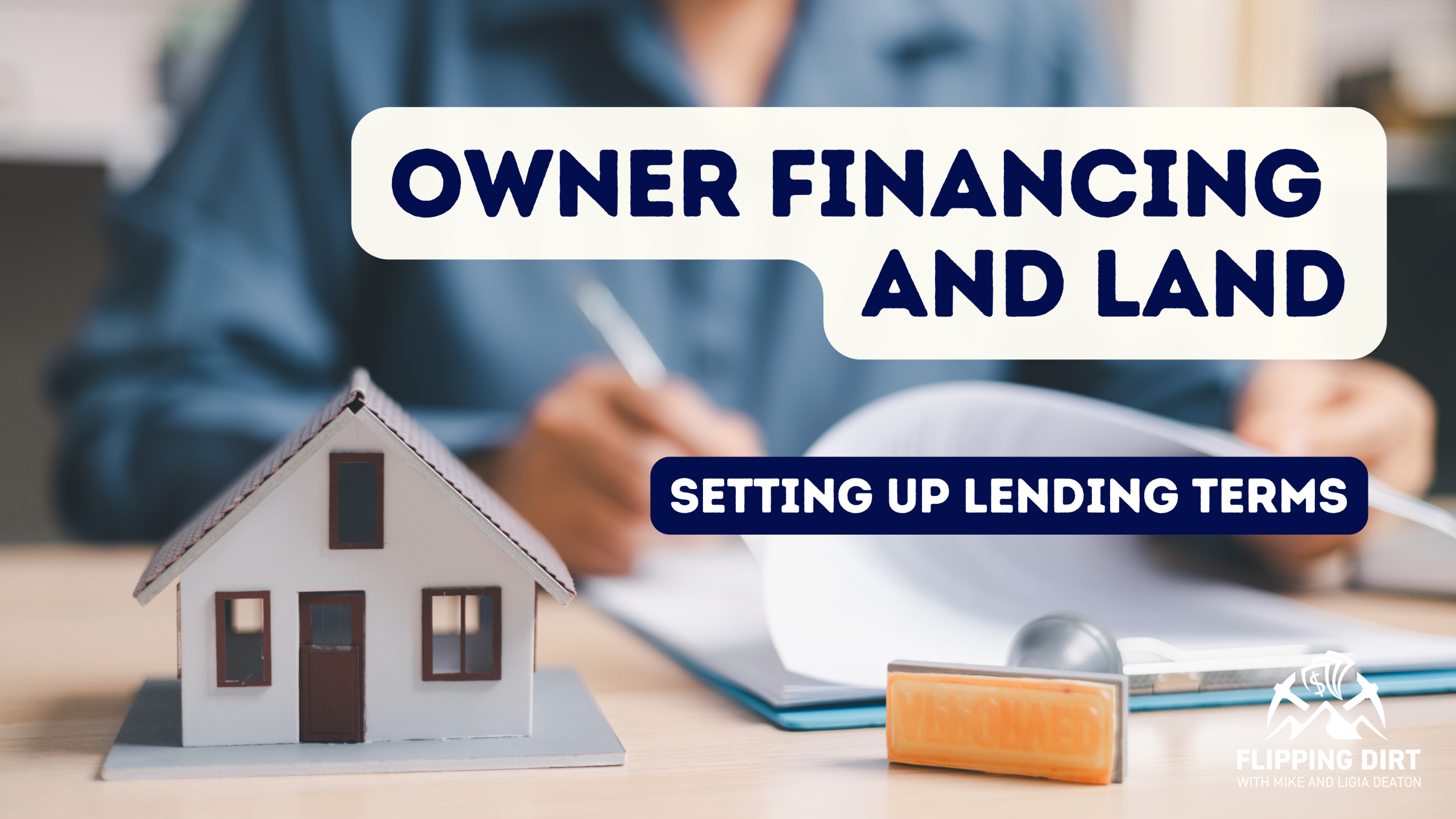
Owner financing, also called seller financing, means you carry the loan yourself instead of sending your buyer to a bank. You agree on a price, a down payment, an interest rate, and a term. They pay you monthly. When the last payment clears, you deliver the deed free and clear.
Most buyers of raw land can’t get a bank loan on it at all – lenders don’t like vacant land, and the terms are poor when they do offer them. That shrinks the cash-buyer pool for any parcel you’re trying to sell. Offering terms opens the property to anyone with a down payment and steady income, which means faster sales and, because you’re setting the rate, more total dollars collected than a cash price would bring. It also converts a one-time flip into monthly income, which is the difference between a business that pays you once and one that pays you every month. We break down that trade-off in Flipping Land vs. Holding Land.
Key Takeaways
- Owner financing means you act as the bank when you sell. It’s a normal, long-standing real estate structure, not a workaround.
- No credit check is standard, because there’s no third-party lender in the transaction to require one.
- Federal mortgage rules like Dodd-Frank apply to loans secured by a dwelling. Vacant land has no dwelling, so it sits outside them, though state law still governs usury, disclosure, and recording.
- Your biggest decision as the seller is contract for deed vs. note and mortgage – it determines how you’re protected if a buyer stops paying.
- Terms convert a one-time flip into years of monthly income, often at a higher total return than a cash sale.
Is it legal to sell land with no credit check?
Yes. The federal rules people usually think of, the Dodd-Frank Act and the SAFE Act, govern residential mortgage loans – loans secured by a dwelling the borrower intends to live in. A dwelling means a house, condo, townhouse, manufactured home, or similar structure. As the National Association of Realtors’ summary of the SAFE Act lays out, these seller-financing rules are built around residential dwellings, which is why loans secured by vacant land sit outside them.
That’s a description of federal scope, not legal advice. States still regulate usury limits, disclosure, recording, and land contracts, and those rules vary. If a deal is large or unusual, an hour with a local real estate attorney is the cheapest insurance in the transaction.
How do you structure an owner-financing sale?
The mechanics are simpler than a mortgage closing. Six steps, usually done in a week or two.
- Set your terms. Purchase price, down payment, interest rate, number of payments, and monthly amount.
- Run title. Confirm you have clean title with no liens or back taxes riding along before you offer terms.
- Choose your paperwork. Either a deed plus a note and mortgage or deed of trust, or a contract for deed. That choice matters – see the next section.
- Record it. The document goes on file at the county so your interest, and the buyer’s, is public.
- Collect monthly. Directly, or through a third-party loan servicer.
- Deliver clear title. On the final payment, release the lien or deliver the deed.
Typical structures on rural land run 10-20% down with terms from 24-84 months. A real example from our own inventory: a parcel we bought for $12,000 and listed at $34,000 sold on terms for $5,000 down plus $750 a month for 72 months. That’s $59,000 total collected on a $12,000 buy, spread over six years instead of one closing.
Contract for deed vs. note and mortgage: which should you use?
This is the single most important structural decision, and it affects your protection as the seller as much as your buyer’s.
| Note and mortgage (or deed of trust) | Contract for deed | |
|---|---|---|
| Who holds title during payments | Buyer does, subject to your lien | You do, as the seller |
| If the buyer stops paying | You foreclose, a formal legal process with notice | In some states, you can retake the property faster through forfeiture |
| Buyer’s equity protection | Stronger for the buyer | Weaker for the buyer, rules vary by state |
| Recorded publicly | Yes | Sometimes not, unless required |
| Common on lower-priced rural land | Yes | Yes, and often preferred by sellers for faster recovery on default |
Contract for deed tends to give you, the seller, a faster and simpler path if a buyer defaults, which is a real reason many land sellers prefer it on lower-priced parcels. A note and mortgage is more buyer-protective and is the more conservative choice if you want the cleanest, most defensible paperwork. Either can work – decide up front and be explicit with the buyer about which one you’re using and why.
What protects you if the buyer stops paying?
A handful of habits keep an owner-financed sale clean on your end:
- Run title before you offer terms. You can’t sell what you don’t clearly own, and unresolved liens or a title problem surface at the worst possible time otherwise.
- State the interest rate in writing. “$750 a month for 72 months” is a payment, not a rate. Document the math so there’s no dispute later about what was agreed.
- Record your interest at the county. An unrecorded deal is a handshake, and handshakes don’t hold up if a buyer disputes the terms.
- Spell out who pays property tax during the term, and confirm every year that it’s actually being paid – unpaid taxes put the parcel at risk regardless of whose job it was.
- Underwrite the parcel, not just the buyer. Terms don’t fix bad dirt. Run access, zoning, and flood risk before you ever list it, the way we lay out in How to Analyze a Land Deal in 10 Minutes or Less.
FAQ
Is it legit to offer owner financing when I sell land?
Yes. Carrying the loan yourself instead of sending the buyer to a bank is a long-standing, legal real estate structure. What matters is clean paperwork and recording your interest at the county.
Why is there no credit check on owner-financed land?
Because there’s no third-party lender in the transaction. As the seller, you’re deciding whether to take the risk yourself, typically managed through the down payment rather than a credit score.
Does Dodd-Frank apply when I seller-finance vacant land?
The federal rules apply to residential mortgage loans secured by a dwelling. Vacant land with no dwelling falls outside that definition, though state law still governs usury, disclosure, and recording.
What down payment should I ask for?
On rural parcels, 10-20% down with terms of two to seven years is common. You’re negotiating directly with a person, not an underwriting department, so terms are flexible.
Should I let a buyer pay off the loan early?
Most sellers do, but spell out the payoff terms in writing and decide up front whether you want a prepayment provision.
Who should pay the property taxes during the term?
Specify it in the contract either way, and verify each year that it’s actually being paid, since an unpaid tax bill puts the parcel at risk no matter who was responsible.
The Paperwork Is What Matters
No credit check isn’t a red flag when you’re the one offering the terms. It’s just what happens when you’re the bank. The questions worth nailing down before you offer terms are the boring ones: which paperwork structure you’re using, what the rate is, whether it’s recorded, and who pays the taxes.
Get clean answers to those four and owner financing becomes one of the most useful tools in land investing – faster sales, a wider buyer pool, and a return that beats most cash exits.
Want to see how we underwrite parcels before we ever offer terms? Start with How to Get Your First Land Deal in 3 Simple Steps, or grab the free resources at Flipping Dirt.
Mike and Ligia Deaton have closed 700+ land deals at 150%+ average annual ROI since both were laid off in 2016.
Flip the script. Live life: elevated.